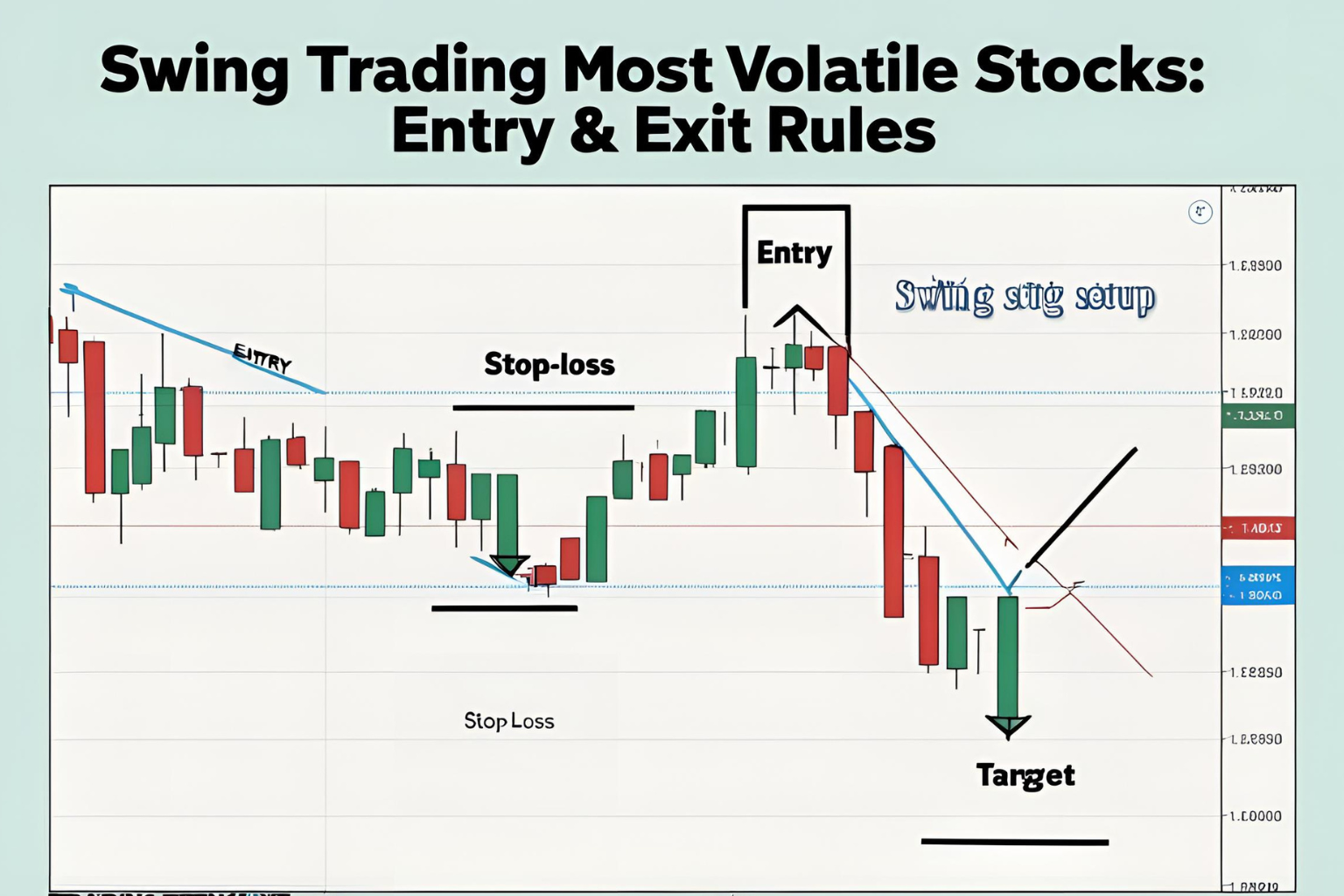
Swing Trading Most Volatile Stocks: Entry & Exit Rules
Swing trading volatile stocks can be incredibly rewarding—if you know how to handle the speed, range, and risk. Unlike day trading, swing trading gives you time to let trades develop, but with volatile stocks, precision still matters.
In this guide, you’ll learn how to swing trade the most volatile stocks, with proven entry and exit rules that help manage risk and improve consistency.
Why Swing Trade Volatile Stocks?
Volatile stocks are stocks that move rapidly—up or down—often due to:
- Earnings reports
- Sector news
- Analyst upgrades/downgrades
- Speculative volume and interest
For swing traders, this means:
- Greater profit potential per trade
- Faster moves to your target
- More setups in less time
But volatility also means:
- Larger drawdowns if unmanaged
- More noise and false breakouts
- Greater need for structure and discipline
Entry Rules for Swing Trading Volatile Stocks
1. Wait for the Setup, Not the Spike
Don’t enter a stock mid-move. Wait for pullbacks, flags, or breakouts from consolidation.
Common Entry Patterns:
- Bull flags
- Breakout of tight ranges
- Support bounces with rising volume
- Reclaims of moving averages (e.g., 20 EMA, 50 EMA)
2. Use Multiple Timeframes
- Analyze trend on the 1-hour or daily chart
- Refine entry using the 15-minute chart
- Confirm with volume and relative strength
3. Check Volume and Relative Strength
Only enter trades with:
- Above-average volume on breakout
- RSI between 50–65 before entry (shows momentum without being overbought)
- Volatility confirmed by rising ATR
4. Know Your Trigger Level
Your entry should be:
- Just above resistance (in a breakout)
- At or near support (in a bounce or retest)
- Accompanied by a clear invalidation point
Exit Rules: Locking in Gains or Cutting Losses
1. Set a Clear Target Before Entering
Use any of the following:
- Prior swing highs/lows
- Measured move from the pattern (e.g., length of flagpole)
- ATR-based projection (1.5x or 2x ATR)
2. Place Stop-Loss Based on Structure, Not Emotions
- Use recent low (for long) or high (for short) as stop
- Or, use ATR-based stop (e.g., 1.2x ATR below entry)
Don’t move your stop unless part of a scaling-out strategy
3. Partial Profits & Trail the Rest
- Take partial profits (e.g., 50%) at your first target
- Move stop to breakeven
- Let the rest ride with a trailing stop or exit signal
4. Time-Based Exits
Volatile stocks move fast. If the trade stalls for 2–3 days, consider exiting to avoid chop.
Example Trade Setup
Ticker: XYZ
Pattern: Bull flag on daily chart
Entry: $24.50 (breakout of flag)
Stop-loss: $22.80 (below flag low)
Target 1: $27.00 (prior high)
Target 2: $29.00 (measured move)
Plan:
- Enter on breakout with strong volume
- Take 50% at Target 1
- Move stop to breakeven
- Exit remaining at Target 2 or use trailing stop
Risk Management Tips
- Never risk more than 1–2% of your account on one trade
- Size down in extremely volatile names (e.g., 8–12% ATR stocks)
- Avoid holding through earnings unless it’s part of the plan
- Use limit orders instead of market orders when possible
FAQs
How long should I hold swing trades in volatile stocks?
Typically 2–5 days. If the stock is stalling, take partial or full profits.
Can I swing trade with a small account?
Yes—use fractional shares or focus on liquid stocks with smaller position sizes.
Is swing trading safer than day trading volatile stocks?
It can be if you’re using defined setups and risk management. But volatility still requires caution.
What’s the best time to enter swing trades?
Late morning or end-of-day setups often provide better signals once early volatility settles.
Should I use options for swing trading volatile stocks?
You can, but choose debit spreads or defined-risk strategies to manage the extra leverage.


